 BeadSheet
中文
Fuse Bead Pattern Maker
Fuse beads, melty beads, iron beads, ironing beads: different names, same craft. Place small plastic tubes on a pegboard, then fuse them with an iron. This free maker turns any picture into a fuse bead pattern for the three most common 5 mm brands. You get a printable chart for every pegboard and a list of exactly which beads to buy.
1 Choose a picture
Or try a sample:
2 Beads & size
3 Colors
Image adjustments
4 Preview
Choose a picture or a sample to see your pattern here.
Bead list (tap a color to highlight it)
| Sym | Color | Code | Beads |
|---|
What counts as a fuse bead?
A fuse bead is a short plastic tube, usually around 5 mm, that softens under the heat of a household iron and bonds to its neighbors. In the US people often just say "Perler beads", in the UK and much of Europe "Hama beads", and many craft shops sell them as "melty beads". They're all the same idea.
Pick your brand (or don't)
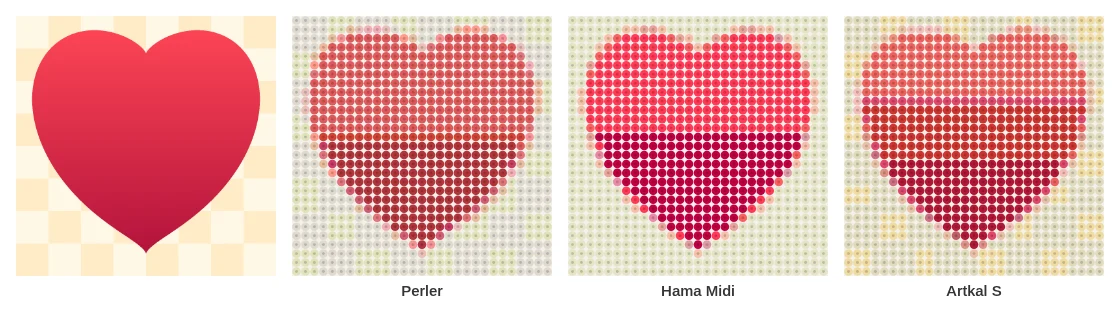
You can make a pattern before you've bought a single bead. Pick a brand in "Bead brand" and the photo is matched to that brand's real colors and codes. Switch brands and it re-matches instantly, so you can compare which one renders your picture best.
| Brand | Palette in BeadSheet | Code style | Good to know |
|---|---|---|---|
| Perler | 103 colors | P01 White, P18 Black (plus item numbers like 80-19001) | Easy to find in US craft stores |
| Hama Midi | 92 colors | H01 White, H18 Black | Danish brand, popular in the UK and Europe |
| Artkal S | 199 colors | S01 White, S13 Black | Widest range, best for photo gradients |
Which should you choose? Use whatever is in your bead box. If you're starting from scratch, buy what's easiest to get locally. If you want photo-realistic portraits, Artkal's extra colors help. For bold, simple designs, any brand works.
Dedicated pages with brand tips: Perler bead pattern maker · Hama bead pattern maker · Artkal bead pattern maker
Bead sizes: mini, midi and maxi
Most fuse beads come in three size classes, and each class has its own pegboards:
- Mini: about 2.5–2.6 mm. Super detailed, needs tweezers and patience.
- Standard / Midi: about 5 mm. The size most patterns, boards and kits are made for. BeadSheet's palettes are all for this class.
- Maxi / Biggie: about 10 mm. Chunky beads for young kids.
Hama lists its Mini at 2.5 mm, while Artkal's minis are 2.6 mm, so mini boards and beads aren't guaranteed to fit across brands. Standard 5 mm beads are generally treated as interchangeable on each other's large square boards.
Planning a fuse bead pattern
Size: think in pegboards
The classic large square board has 29 × 29 pegs, which comes to about 14.5 cm (5.7 in) per side with 5 mm beads. Choose the number of boards wide and tall, and BeadSheet shows the finished size in cm and inches before you start. Common layouts:
- 1 board (29 × 29, 841 beads): coasters, magnets, keychains
- 4 boards (58 × 58, 3,364 beads): pets, flowers, names, small portraits
- 9 boards (87 × 87, 7,569 beads): detailed portraits and wall art
Non-square layouts (2 × 1, 1 × 2, 3 × 2, 2 × 3) and custom sizes up to 200 × 200 beads are available too. Got a board with a different peg count? Type it in and the PDF splits the design to match.
→ Ready-made presets: Perler 29x29 · Perler 58x58 · Hama 58x58
Colors: fewer is often better
Every extra color is another bag to buy and another pile to sort. Use the "Max colors" cap: a small design rarely needs more than 12, and a four-board portrait usually looks great at 20–30. Switch on dithering only for gradients like skies or skin, because it scatters single beads that take longer to place.
Already made pixel art? Keep it 1:1
If your image is already a pixel-art sprite, choose Custom size and enter the sprite's exact pixel width and height. Then set colors to No limit and leave dithering off. Every pixel becomes exactly one bead, and each color snaps to the closest real bead. Transparent pixels in a PNG are left as empty pegs.
From pattern to finished piece
- Print. The PDF opens with an overview and the complete bead list, then gives one page per pegboard. Column and row numbers run across the whole design, a mini map shows which board you're on, and each page lists the colors and counts for that board. Want a 1:1 template? Tick "Print beads at ~actual size (5 mm)" and print at 100%.
- Place the beads. Work one board at a time. Tap a color in the bead list to highlight it in the preview. It's an easy way to place one color at a time.
- Fuse. Cover with ironing paper and use a dry iron, no steam. Each brand recommends something slightly different. Perler suggests a medium setting with a slow circular or back-and-forth motion. Hama suggests the cotton setting, keeping the iron moving. Artkal suggests 160–180 °C, holding about 2–3 seconds at a time. Always test a small patch first. An adult should do the ironing.
- Flatten. Let the piece cool under a heavy book so it doesn't curl.
Frequently asked questions
Is "fuse beads" the same as Perler or Hama beads?
Yes. "Fuse beads" is the generic name. Perler, Hama and Artkal are brands of fuse beads. "Melty beads" and "iron beads" mean the same thing.
Which fuse bead brands are supported?
Perler (103 colors), Hama Midi (92) and Artkal S (199) in 5 mm, plus two 2.6 mm mini palettes: Artkal M (220 usable colors) and MARD 221 / 291. Hama Mini and maxi palettes aren't included yet.
Can I mix brands in one project?
Many people do with 5 mm beads, but shades and fusing behavior differ. Test a small patch and keep each brand to whole color areas. Or regenerate the pattern for the beads you have most of.
Can I make a pattern from only the beads I own?
Yes. Tick your colors in My colors and switch on "Only use colors I own".
What do I get when I download?
A PDF (overview, bead list and one page per pegboard, on Letter or A4), a PNG image and a CSV bead list with codes, names and counts.
Do I need an account?
No. It's free, nothing to install, and your pictures stay on your device.